


Authored by Sara Bailey, our long-standing collaborator.
Busy parents seeking indoor activities know the moment when the walls start to feel smaller, and kids’ energy gets bigger. The real indoor child entertainment challenge isn’t finding something to do; it’s keeping children happily engaged without defaulting to screens or constant cleanup. With the right mindset, children’s educational play can feel less like a box to check and more like family bonding time that actually supports child development at home. A handful of simple, low-pressure options can make an ordinary afternoon feel steadier for everyone.
Quick Summary of Indoor Learning Fun
- Try simple science experiments to spark curiosity and build basic problem-solving skills.
- Play educational board games to practice counting, reading, strategy, and teamwork.
- Create arts and crafts projects to strengthen creativity, fine motor skills, and self-expression.
- Start indoor gardening projects to teach responsibility, patience, and how plants grow.
- Practice children’s relaxation techniques to calm bodies, reset moods, and support focus.
Build a Flashcard Game Night That Boosts Words and Memory
When you need another quick win that still feels like real learning, flashcards can turn a few spare minutes indoors into a lively little game night. Parents can use flashcards for simple, hands-on learning games that keep kids engaged while they practice vocabulary, math, memory, and other skills- think quick vocabulary challenges, speedy recall races, or matching cards to test recognition and focus. The beauty is how flexible they are: the same format can reinforce new words, basic equations, or anything your child is working on.
If you’re short on time, this easy flashcard maker can be faster with an AI flashcard maker that takes uploaded notes, PDFs, slides, and other study materials and turns them into organized digital flashcards. It automatically pulls out key terms, definitions, formulas, and important concepts, so you can spend less time prepping and more time playing.
Mix and Match: Cozy Activities That Teach While They Play
Some days your kid wants to move; other days they want to make; and sometimes they just need a calm reset. Here’s a mix-and-match menu you can pull from, easy to start, flexible by age, and surprisingly educational.
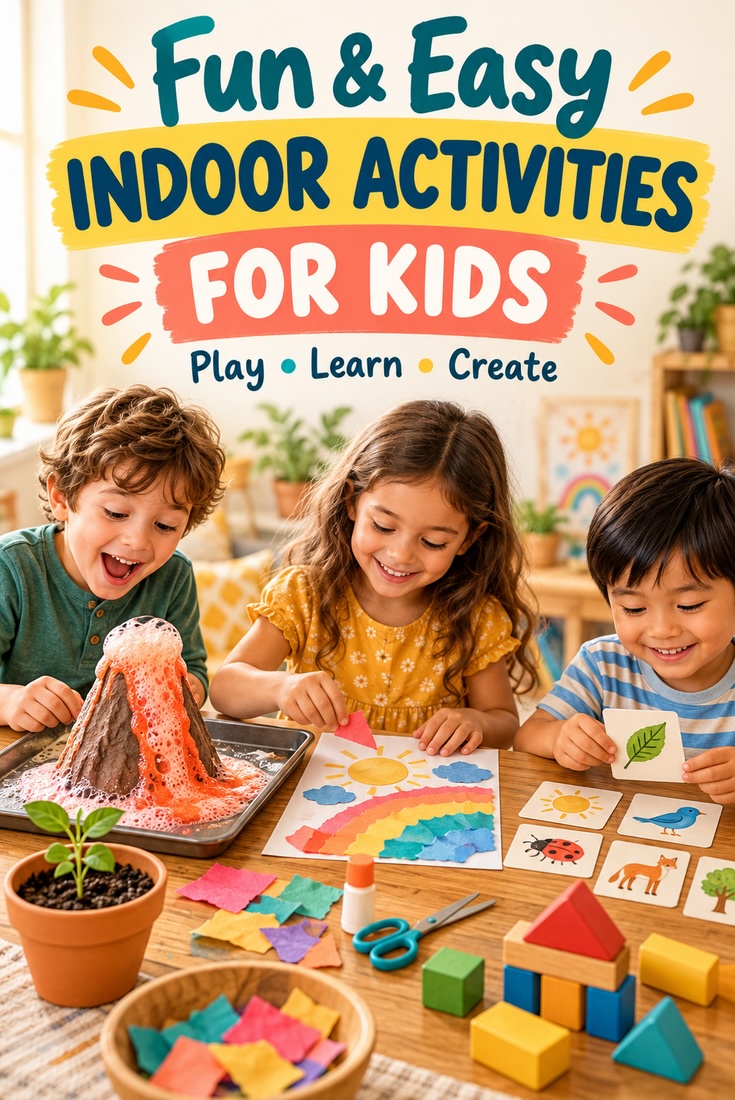
- Build a “Kitchen-Table” DIY Science Kit: Pick one theme per day (bubbles, magnets, or plants) and drop 5–8 items into a shoebox: food coloring, vinegar, baking soda, a magnet, paper clips, measuring spoons, and a notebook. Give one simple challenge: “Make the biggest bubble” or “Sort what the magnet grabs,” then have them write or draw the result. It works because kids can test ideas quickly, and the notebook quietly turns play into observation practice.
- Turn Cooking Lessons for Kids Into Math + Reading Practice: Choose a recipe with 6–10 steps (smoothies, muffins, quesadillas) and assign roles: your child reads the steps aloud while you handle the oven or sharp tools. Ask them to double or halve one ingredient and explain the change; this sneaks in fractions without a worksheet. If you’ve been doing flashcard game night, keep 5 “kitchen words” flashcards nearby (stir, measure, whisk, sprinkle, slice) and let them “win” a card by using the word correctly.
- Go All-In on Hands-On Arts and Crafts, With a Skill Focus: Instead of “make anything,” choose one technique for 20 minutes: weaving paper strips, stamping with sponges, or collage with magazine letters. Add a mini goal like “use only warm colors” or “include three textures,” which nudges planning and decision-making. The hobby is wildly popular in the real world too; an arts and crafts market doesn’t grow unless making things genuinely holds attention.
- Write a Mini Play (Then Perform It Tonight): Give a tight structure: 3 characters, 1 problem, 1 silly solution, and a beginning-middle-end that fits on one page. Younger kids can dictate while you write; older kids can draft dialogue and stage directions. Use your flashcards as surprise “prop prompts”, they pull two cards and must work the words into the script.
- Try Mindfulness Exercises for Children That Feel Like Games: Keep it short, 2 to 5 minutes, so it doesn’t feel like “one more task.” Do “teddy bear breathing” (stuffed animal rises and falls on the belly), “five-finger breathing” (trace fingers as they inhale/exhale), or a 60-second sound hunt (name five sounds). This works especially well as a transition between higher-energy activities and quieter ones like reading or crafting.
- Design-and-Build Challenge: Create Something From a Plan: Start with a quick sketch on graph paper, then build the model using straws, cardboard, and tape. A prompt like design an original jungle gym gives kids a concrete “client” problem to solve- fun, but also engineering-thinking. For older kids, add constraints: “It must fit on one sheet of cardboard” or “It needs two moving parts.”
Indoor Activity Prep Checklist (Save This)
This quick list turns a good idea into an activity that actually happens, even on busy afternoons. Use it as your activity preparation checklist so indoor learning setup feels simple, not like another project.
✔ Choose one activity type for today
✔ Gather a small materials bin for kids’ activities
✔ Set a 20- to 40-minute timer
✔ Write one clear challenge or goal
✔ Prep one safe workspace and simple cleanup plan
✔ Add one learning hook: count, read aloud, or record results
✔ Track what worked in two quick notes
You did the setup; now you can relax and enjoy the moment.
Ending Indoor Activity Time With Calm, Curious Learners
When everyone’s been cooped up, and attention is running thin, it’s easy for “learning time” to feel like one more thing to manage. A gentle, playful mindset, supported by simple prep, supportive parenting approaches, and small family engagement strategies, keeps fun educational experiences within reach without turning home into a classroom. The benefits of indoor learning show up in quieter transitions, steadier moods, and kids who start to see curiosity as something they can choose, not a chore. Indoor learning works best when it feels like play, not pressure.